Majalah Bisnis & IPTEK Crossmark Policy Page
Open Access & Archiving Policy
Ownership & Management Information
Allegations of Research Misconduct Policy
JOURNAL TEMPLATE
Recommended Tool


From Vol 16(2) 2023 Sinta 4
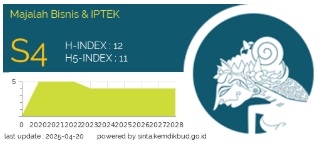
Download Sertifikat Akreditasi


Majalah Bisnis & Iptek
Majalah Bisnis & Iptek is unequivocally committed to safeguarding the highest echelons of scientific, technological, and professional integrity in academic publishing. The Editorial Board treats all allegations of research misconduct with the utmost gravity, adjudicating them with strict confidentiality, rigorous impartiality, and meticulous diligence. All investigative procedures are explicitly aligned with the ethical frameworks and procedural flowcharts established by the Committee on Publication Ethics (COPE).
1. Defining Research Misconduct Within the interdisciplinary context of business management and applied sciences, research misconduct is defined as any deliberate, deceptive, or highly reckless deviation from universally accepted ethical standards during the execution, analysis, or reporting of research. This encompasses, but is not limited to:
Data Falsification and Fabrication: The intentional invention, distortion, or deceptive manipulation of empirical data, technical specifications, software outputs, statistical analytics, or graphical representations to falsely support a hypothesis.
Plagiarism and Intellectual Appropriation: The unauthorized or uncredited assimilation of another entity's textual content, conceptual frameworks, proprietary business models, computer code, or empirical findings. This includes egregious self-plagiarism (redundant publication or "salami-slicing").
Authorship Transgressions: The manipulation of author credentials, including ghost authorship (omitting legitimate contributors), gift authorship (crediting unqualified individuals), or the unauthorized inclusion of researchers without their explicit consent.
Ethical and Regulatory Violations: Conducting research that breaches corporate confidentiality agreements, bypasses mandatory Institutional Review Board (IRB) approvals, violates participant privacy, or fails to declare severe conflicts of interest.
2. Investigative Protocol and Management of Allegations Suspicions of ethical breaches may be initiated by peer reviewers, editorial board members, independent readers, or whistleblowers. The publication enforces the following structured protocol to address such claims:
Confidential Reporting: All allegations must be directed to the Editor-in-Chief. To protect against potential professional retaliation, the identity of the informant (whistleblower) will be preserved under strict confidentiality throughout the entirety of the investigation.
Preliminary Editorial Assessment: The Editorial Board will conduct an initial triage of the submitted evidence to evaluate the substantive validity, scope, and severity of the allegations.
Author's Right of Rebuttal: Should the allegations demonstrate substantive merit, the Editor-in-Chief will formally notify the corresponding author. The implicated authors will be afforded a designated timeframe to submit a comprehensive written explanation, raw datasets, technical logs, or any exonerating documentation.
Institutional Escalation: In scenarios where the authors' defense is evasive, scientifically inadequate, or reveals profound ethical negligence, the editorial board reserves the absolute right to escalate the inquiry. This may involve formally alerting the authors' affiliated academic institutions, corporate employers, funding sponsors, or relevant regulatory authorities.
3. Remedial Interventions and Sanctions If a comprehensive investigation conclusively dictates that research misconduct has transpired, Majalah Bisnis & Iptek will implement decisive punitive and corrective measures proportionate to the severity of the transgression:
Pre-Publication Sanctions: If the manuscript is still under review, it will be immediately rejected. The offending authors may face a formal embargo, barring them from submitting future manuscripts to the publication for a specified multi-year period.
Post-Publication Sanctions: If the compromised manuscript has already been published, the journal will intervene to correct the academic record. For profound breaches that irreparably invalidate the research findings (e.g., fabricated data, severe plagiarism), the journal will issue a formal Retraction Notice, permanently linking the notice to the original digital record while watermarking the PDF as "RETRACTED." In cases where an investigation is ongoing or results are ethically ambiguous, the journal may publish an Expression of Concern to alert the scholarly community.
Majalah Bisnis & IPTEK Crossmark Policy Page
Open Access & Archiving Policy
Ownership & Management Information
Allegations of Research Misconduct Policy
JOURNAL TEMPLATE
Recommended Tool
From Vol 16(2) 2023 Sinta 4
Download Sertifikat Akreditasi