Majalah Bisnis & IPTEK Crossmark Policy Page
Open Access & Archiving Policy
Ownership & Management Information
Allegations of Research Misconduct Policy
JOURNAL TEMPLATE
Recommended Tool



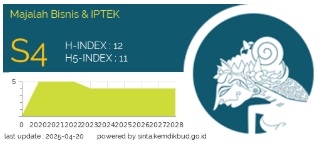
From Vol 16(2) 2023 Sinta 4
Download Sertifikat Akreditasi



The publication of an article in a peer-reviewed journal is an essential building block in the development of a coherent and respected network of knowledge. It is a direct reflection of the quality of the work of the authors and the institutions that support them. Peer-reviewed articles support and embody the scientific method. It is therefore important to agree upon standards of expected ethical behavior for all parties involved in the act of publishing: the author, the journal editor, the peer reviewer, the publisher and the society of society-owned or sponsored journals. The Majalah Bisnis & IPTEK, follow COPE Principles of Transparency and Best Practice Guidelines and the COPE Code of Conduct. The authors can find out about publication ethics clearly on https://publicationethics.org.
Majalah Bisnis & Iptek
Majalah Bisnis & Iptek is unequivocally committed to preserving the paramount standards of scholarly integrity and publication ethics. All stakeholders engaged in the publication lifecycle—comprising authors, the editorial board, and peer reviewers—are strictly obligated to endorse and comply with the ethical frameworks delineated below. These protocols are meticulously aligned with the foundational codes of conduct promulgated by the Committee on Publication Ethics (COPE).
Decision-Making and the Peer Review Ecosystem The Editor-in-Chief, in conjunction with the Editorial Board, guarantees that all submitted manuscripts are subjected to a rigorous double-blind peer review conducted by at least two independent subject-matter experts. The ultimate authority to accept or reject a submission resides with the Editor-in-Chief, whose adjudications are fundamentally guided by:
The scientific validity, methodological rigor, and theoretical or practical impact of the research within the realms of business and applied technology.
The manuscript’s alignment with the publication’s interdisciplinary scope.
The critical evaluations and formal recommendations provided by the peer reviewers.
Strict adherence to legal statutes concerning copyright infringement, defamation, and plagiarism.
Absolute Impartiality All manuscripts are appraised exclusively on their intellectual, technical, and scientific merit. The editorial evaluation process is strictly insulated from any considerations regarding the authors' race, gender identity, sexual orientation, religious convictions, ethnic background, citizenship, institutional affiliations, or political ideologies.
Confidentiality Protocols The editorial staff is bound by a strict mandate of confidentiality. No details pertaining to a submitted manuscript will be divulged to any entity other than the corresponding author, assigned peer reviewers, prospective reviewers, and authorized editorial consultants.
Conflicts of Interest and Disclosure
Protection of Unpublished Material: Editors are categorically prohibited from utilizing unpublished data, conceptual frameworks, or theoretical arguments extracted from a submitted manuscript for their personal research endeavors without explicit, written authorization from the authors.
Mandatory Recusal: Editors must systematically recuse themselves from adjudicating manuscripts where they harbor a competing interest, collaborative history, or institutional conflict with the authors or associated corporate entities. In such events, the manuscript will be reassigned to an impartial member of the Editorial Board.
Management of Ethical Grievances Should allegations of ethical misconduct—such as plagiarism, data fabrication, or authorship manipulation—be directed at a submitted draft or a published article, the editorial team will initiate an immediate and exhaustive investigation in strict accordance with COPE procedural flowcharts, regardless of the manuscript's publication date.
Scientific Integrity and Reporting Standards Authors submitting empirical, theoretical, or technical research must deliver an entirely accurate representation of their executed work, complemented by an objective interpretation of the findings. The underlying data must be presented with absolute veracity. Manuscripts are required to feature sufficient methodological granularity and comprehensive bibliographic citations to facilitate subsequent replication by the scientific community. The inclusion of fraudulent, intentionally distorted, or deceptive statements is classified as severe ethical misconduct.
Originality and the Condemnation of Plagiarism Authors are bound to ensure their submissions are entirely original creations. Any incorporation of external data, textual excerpts, or conceptual paradigms must be rigorously cited and appropriately quoted.
Plagiarism in any manifestation—encompassing verbatim appropriation, uncredited paraphrasing, self-plagiarism (redundant publication), or the usurpation of another's research findings—is fundamentally intolerable.
All submissions to Majalah Bisnis & Iptek undergo compulsory digital screening via Turnitin. Furthermore, authors are required to submit a formal Statement of Originality, legally affirming that the manuscript is devoid of plagiarized content.
Prohibition of Redundant or Concurrent Submissions Authors are forbidden from publishing manuscripts that detail essentially identical research across multiple journals. The simultaneous submission of a single manuscript to Majalah Bisnis & Iptek and any other publishing venue constitutes a severe breach of academic ethics and is strictly proscribed.
Attribution of Sources and Confidentiality Authors must systematically acknowledge all sources that have shaped their research trajectory. Information acquired through private channels (e.g., confidential correspondence, industry discussions) or during secure academic service (e.g., evaluating grant proposals or reviewing manuscripts) must never be utilized without explicit, written permission from the originating source.
Authorship Criteria Authorship is an academic credential strictly reserved for individuals who have delivered substantive intellectual contributions to:
The foundational conception, structural design, or technical acquisition of the study's data;
The analytical processing and theoretical interpretation of the research outcomes; and
The critical drafting or intellectual refinement of the manuscript. All personnel fulfilling these criteria must be officially designated as co-authors. Individuals offering strictly administrative, technical, or linguistic support should be credited exclusively within the Acknowledgements section. The corresponding author is responsible for verifying that all co-authors have authorized the final draft and consented to its submission.
Disclosure of Funding and Competing Interests Authors must transparently declare any financial, commercial, or personal affiliations that could be construed as biasing their research design or conclusions. All external sources of financial sponsorship, institutional grants, or corporate funding must be explicitly detailed within the manuscript.
Post-Publication Corrections Should an author identify a profound error or significant inaccuracy in their published work, it is their ethical duty to instantly notify the editorial board and cooperate proactively to orchestrate the publication of an erratum, corrigendum, or formal retraction notice.
Editorial and Academic Contribution The peer-review mechanism is the bedrock of academic publishing. Reviewers assist the editorial board in executing informed publication decisions while simultaneously providing authors with critical feedback to elevate the scientific rigor and clarity of their manuscripts.
Punctuality and Availability Any invited referee who deems themselves underqualified to assess the technical or business dimensions of a manuscript, or who cannot fulfill the review within the stipulated timeframe, must immediately inform the editor and decline the invitation.
Strict Confidentiality Reviewers must treat all assigned manuscripts as highly classified documents. The contents, methodologies, and findings must not be disseminated, discussed, or exposed to unauthorized third parties without the prior, explicit consent of the Editor-in-Chief.
Objective and Constructive Evaluation Peer reviews must be executed with absolute objectivity and professional decorum. Ad hominem attacks or personal critiques directed at the authors are strictly forbidden. Referees are expected to articulate their technical and theoretical evaluations lucidly, fortified by reasoned argumentation and pertinent academic literature.
Identification of Unattributed Sources Reviewers are tasked with identifying highly relevant, published literature that the authors have failed to cite. Any assertion that a specific methodology, conceptual argument, or empirical finding has been previously documented must be substantiated with a precise citation. Reviewers must immediately alert the editorial board if they detect substantial textual overlap or conceptual mirroring between the submission and any previously published works.
Conflict of Interest Mitigation Intellectual property or novel concepts encountered during the review process must remain strictly confidential and cannot be exploited for the reviewer’s personal or professional advancement. Reviewers must categorically recuse themselves from evaluating any manuscript where they recognize a financial, institutional, or collaborative conflict of interest with the authors or their affiliated organizations.
To protect intellectual property, ensure algorithmic transparency, and uphold human accountability, Majalah Bisnis & Iptek enforces strict parameters regarding the utilization of AI and Large Language Models (LLMs):
Human Accountability: Authors and reviewers bear sole and untransferable responsibility for the accuracy, originality, and ethical compliance of their work. AI tools serve strictly as auxiliary aids, never as substitutes for human critical analysis.
Prohibited Applications: The deployment of generative AI to architect original scholarly content (e.g., drafting abstracts, synthesizing literature, formulating theoretical frameworks, or generating empirical data/figures) is strictly forbidden. Because AI entities lack legal and ethical agency, they cannot be credited as authors or co-authors.
Permitted Applications: Authors may employ AI-assisted technologies exclusively for the linguistic refinement, structural formatting, and grammatical copy-editing of their pre-existing, original text.
Mandatory Disclosure: Any permitted utilization of AI tools must be transparently declared within the manuscript (e.g., in an AI Statement or Acknowledgements section), detailing the specific software, version, and exact application.
Confidentiality in Peer Review: Editors and peer reviewers are strictly prohibited from uploading submitted manuscripts, proprietary data, or graphical figures into generative AI platforms, as this constitutes a profound violation of authorial confidentiality and intellectual property rights.
Authors submitting empirical or technical research to Majalah Bisnis & Iptek must incorporate a dedicated Research Ethics Statement within their manuscript.
Prerequisites for Empirical and Field Studies For investigations involving human participants, corporate case studies, field surveys, or the utilization of confidential industry data, authors must explicitly articulate:
The ethical frameworks and protocols adhered to during the data acquisition phase.
Whether formal clearance was secured from an Institutional Review Board (IRB) or recognized Ethics Committee (including the authorizing entity's name, reference number, and approval date).
If formal institutional oversight was deemed unnecessary, a rigorous justification must be provided, detailing the alternative safeguards implemented to ensure ethical compliance.
Unequivocal confirmation that informed, voluntary consent was obtained from all participating individuals or corporate entities.
The specific mechanisms deployed to guarantee participant anonymity, data privacy, and the secure handling of proprietary information.
Prerequisites for Non-Empirical Submissions For conceptual frameworks, systematic literature reviews, or theoretical models that do not rely upon primary empirical data collection, authors must embed the following standardized declaration:
Research Ethics Statement: Formal ethical approval was not mandated for this study, as the manuscript does not incorporate or analyze primary empirical data collected from human subjects, live field experiments, or confidential corporate datasets.
Majalah Bisnis & IPTEK Crossmark Policy Page
Open Access & Archiving Policy
Ownership & Management Information
Allegations of Research Misconduct Policy
JOURNAL TEMPLATE
Recommended Tool
From Vol 16(2) 2023 Sinta 4
Download Sertifikat Akreditasi