Majalah Bisnis & IPTEK Crossmark Policy Page
Open Access & Archiving Policy
Ownership & Management Information
Allegations of Research Misconduct Policy
JOURNAL TEMPLATE
Recommended Tool



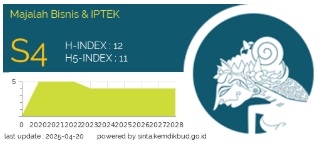
From Vol 16(2) 2023 Sinta 4
Download Sertifikat Akreditasi



Majalah Bisnis & Iptek
Majalah Bisnis & Iptek recognizes the accelerating utilization of artificial intelligence (AI) and algorithmically driven technologies within contemporary business, applied sciences, and scholarly publishing. To rigorously protect intellectual property, uphold empirical integrity, and mandate transparent authorship, the publication enforces the following regulatory framework concerning the deployment of AI during manuscript preparation and the peer-review process.
1. Foundational Principles of AI Integration
Absolute Human Accountability: The ultimate responsibility for a manuscript’s empirical accuracy, original thought, ethical compliance, and overall scientific integrity resides exclusively with the human authors and peer reviewers. The application of AI technologies does not mitigate, transfer, or diminish this fundamental human accountability.
Ethical Transparency: The integration of AI assistance must be conducted with absolute transparency. Authors must guarantee that algorithmic interventions do not violate copyright protocols, misrepresent empirical or commercial data, or compromise the honesty of the academic record.
AI as a Supplementary Mechanism: Artificial intelligence is strictly categorized as an auxiliary instrument intended to refine and support scholarly communication. It must never usurp human critical thinking, replace substantive intellectual contributions, or act as a substitute for authoritative scientific and managerial judgment.
2. Prohibited and Permissible Applications of AI
Strictly Prohibited (Generative Content Creation): The utilization of Large Language Models (LLMs) and generative AI platforms to author, synthesize, or artificially construct foundational text, theoretical frameworks, empirical data, statistical tables, graphical figures, or comprehensive literature reviews is categorically forbidden. Furthermore, because AI systems inherently lack legal accountability and ethical agency, they definitively fail to meet the established criteria for authorship and must never be credited as an author or co-author under any circumstances.
Permissible Usage (Linguistic Refinement): Authors are permitted to employ AI-driven applications exclusively for the linguistic enhancement and structural copy-editing of their pre-existing, original work. AI tools may be leveraged to elevate grammatical precision, syntactic flow, and overall readability, strictly on the condition that such interventions do not distort, manipulate, or alter the underlying scientific intent and empirical meaning of the research. Standard spelling and grammar checkers do not require formal disclosure.
3. Mandatory AI Disclosure Requirements Any permissible utilization of AI tools during the manuscript preparation phase must be transparently declared. Authors must include a dedicated AI Usage Statement (placed within or adjacent to the Acknowledgements section) that explicitly details the name of the software, the specific version utilized, and the exact scope of its application.
Exemplar Declaration: "The authors transparently disclose the use of [Insert AI Tool/Version] exclusively for the purpose of linguistic editing and grammatical refinement of the original draft. The authors maintain full responsibility for the manuscript's substantive content, data integrity, and final scientific conclusions."
4. AI Regulations for the Editorial and Peer-Review Workflow To safeguard authorial confidentiality, prevent premature data disclosure, and protect proprietary intellectual property, the editorial staff and peer reviewers are strictly prohibited from uploading submitted manuscripts, raw datasets, or graphical figures into external generative AI platforms. The evaluation of scientific merit, technical validity, and editorial suitability must be executed entirely by independent human experts.
Majalah Bisnis & IPTEK Crossmark Policy Page
Open Access & Archiving Policy
Ownership & Management Information
Allegations of Research Misconduct Policy
JOURNAL TEMPLATE
Recommended Tool
From Vol 16(2) 2023 Sinta 4
Download Sertifikat Akreditasi